


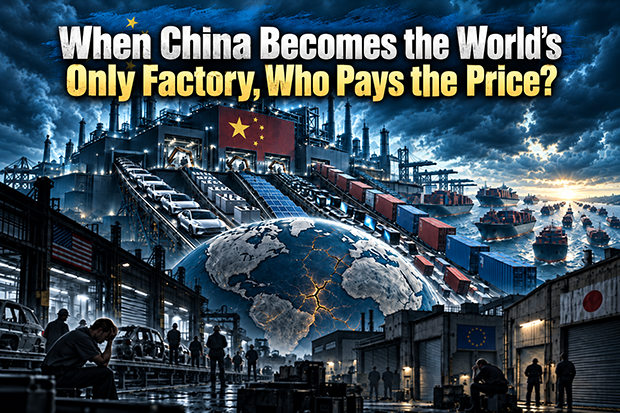


By Mohamad Salman the Editor-in-Chief of Business News
Since the Industrial Revolution began in Britain in the 18th century, the global economy has been built around multiple centers of industrial power. Manufacturing strength later expanded across Europe, the United States and Japan, followed by emerging Asian economies. Factories, jobs, investment and wealth were therefore distributed across a broad group of countries.
That balance was never perfect, but for decades it prevented global manufacturing from becoming concentrated in the hands of a single economy.
Today, that balance is facing a serious test.
China is no longer simply a country benefiting from low-cost labor or producing inexpensive goods. It has become an industrial powerhouse with enormous factories, integrated supply chains, advanced technological capabilities, and a growing presence in automobiles, batteries, electronics, solar technology, machinery and heavy industry.
The problem is not China’s success, nor its ability to manufacture efficiently.
The problem begins when that strength turns into massive excess production that is pushed into international markets at prices local manufacturers in many countries struggle to match.
At that point, this is no longer ordinary competition.
It becomes a battle for industrial survival.
The Cheap Car May Be Only the Beginning
Electric vehicles provide one of the clearest examples.
Chinese manufacturers can now offer technologically advanced vehicles at highly competitive prices, supported by their strength across much of the battery supply chain, economies of scale and extensive industrial support.
For consumers, that can be attractive in the short term.
But what happens when an imported vehicle becomes so inexpensive that domestic manufacturers can no longer compete profitably?
The consequences are predictable: lower production, job cuts, frozen investment, factory-line closures and, eventually, the possible exit of entire companies from the market.
If this happened only in the automotive sector, major economies might be able to absorb the damage.
But if the same pattern spreads across steel, solar panels, batteries, electronics, machinery, chemicals and energy equipment, the result could be the gradual hollowing out of the industrial base of entire economies.
It Is Not Only About Prices
Some will ask: what is wrong with consumers getting cheaper products?
The problem is that citizens are not consumers alone.
They are also employees, factory workers, taxpayers and business owners.
Governments cannot sustain their economies through cheap imports alone. They depend on economic activity, domestic production, employment, corporate profits, investment and tax revenues.
If factories close and jobs disappear, a cheaper car will not compensate a worker for a lost salary, nor will it replace the public revenues generated by productive domestic industries.
Flooding markets with very low-priced goods may therefore deliver a short-term benefit to consumers while eventually creating a far greater economic and social cost.
A Country That Loses Its Industry Loses Part of Its Sovereignty
Manufacturing is more than a commercial activity.
It represents skills, technology, supply chains, engineering knowledge and the capacity to produce essential goods during times of crisis.
The COVID-19 pandemic, followed by geopolitical disruptions, demonstrated how excessive dependence on foreign suppliers for strategic products can quickly become a major vulnerability.
Losing domestic industries therefore means more than losing jobs. It can also mean losing part of a country’s strategic capability.
A nation unable to manufacture critical components, machinery, transport equipment or key technologies becomes increasingly dependent on others and increasingly vulnerable to political and economic shocks.
The World Will Not Accept This Indefinitely
It would be unrealistic to expect the world’s major industrial powers to watch factories close and hundreds of thousands of jobs disappear without reacting.
That reaction has already begun.
Tariffs, government incentives for domestic manufacturers, reshoring programs, investment and technology restrictions, and policies designed to reduce dependence on China in strategic sectors are becoming increasingly common.
This means trade tensions are likely to intensify.
The greater the excess production entering international markets, the greater the political pressure within competing economies to impose stronger protective measures.
A confrontation may begin with tariffs, then move toward technology restrictions, investment barriers and eventually the division of global supply chains into competing economic blocs.
At that point, everyone pays the price.
China Will Pay a Price Too
The irony is that this model could ultimately damage China itself.
If Chinese factories increasingly depend on overseas markets to absorb enormous volumes of excess production, and those markets begin closing their doors or imposing significant tariffs, Chinese companies could face a different kind of crisis: enormous factories, huge production capacity and weakening international demand.
Competition within China could then intensify into price wars, profit margins could fall, weaker businesses could fail, and pressure on the broader economy could increase.
A growth model built around unlimited industrial expansion and continuously rising exports cannot continue indefinitely.
The Greatest Risk May Ultimately Be Political
History shows that industrial decline, rising unemployment and falling living standards rarely remain purely economic issues.
They quickly become sources of social anger and political pressure.
When citizens believe their jobs and futures are being threatened by imports and foreign competition, they demand protection from their governments.
And when governments compete to protect their factories and their citizens’ jobs, policy inevitably becomes more aggressive.
That is why the real danger is not simply that China can sell products more cheaply.
The greater danger is that a severe imbalance in global manufacturing could trigger a new wave of protectionism and economic confrontation capable of reversing decades of international economic integration.
The World Needs China — But It Cannot Depend on China Alone
No one can deny that China has provided the world with affordable products, helped build highly efficient global supply chains and contributed to lowering the cost of important technologies, including solar panels, batteries and electric vehicles.
But China’s industrial success should not require the disappearance of manufacturing elsewhere.
A more stable global economy is one with multiple centers of production — where Europe, the United States, Japan, South Korea, India, the Gulf economies and emerging markets manufacture alongside China.
Turning the rest of the world into one enormous consumer market supplied predominantly by a single manufacturing powerhouse is not healthy globalization.
It is dangerous industrial dependence.
A strong China can benefit the world.
But a China that becomes almost the world’s only factory could shift from being an engine of global trade to becoming a source of dangerous imbalance within it.
The question the world should be asking today is not whether China can produce more.
It is this:
How many industries can the world afford to lose before it discovers that the cheapest price was far more expensive than it appeared?