


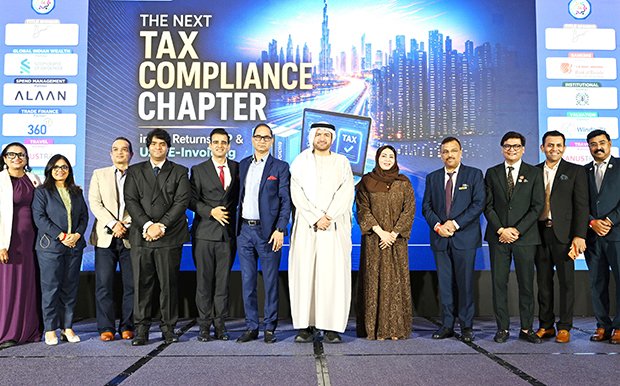

Dubai, UAE, 28 September 2026: UAE businesses have been urged to use the remaining months to prepare for the country’s mandatory e-invoicing regime, which is scheduled to begin phased implementation from 1 January 2027.
The call came during a conference titled “The Next Tax Compliance Chapter in Corporate Tax Returns, Transfer Pricing and E-Invoicing”, organised by the Dubai Chapter of the Institute of Chartered Accountants of India (ICAI) and attended by more than 500 professionals.
The UAE’s e-invoicing system, overseen by the Federal Tax Authority (FTA), is designed to improve tax transparency, reduce fraud and support the country’s wider digital transformation strategy. The system will enable the secure and structured exchange of invoice data between businesses, while also facilitating reporting to the FTA.
Dr. Zahra Al Dahmani, Director of Taxpayer Services Department at the Federal Tax Authority, said e-invoicing should not be viewed simply as another compliance requirement.
“E-Invoicing represents another important step in the UAE’s digital transformation and in the continued development of a tax system that is efficient, transparent and designed to support a modern economy.”
She said the UAE had adopted a decentralised continuous transaction control and exchange framework, widely known as the Five-Corner Model, under which businesses will exchange e-invoices through accredited service providers using internationally recognised standards.
Al Dahmani added that the programme has now moved into its pilot phase, with participating businesses able to onboard accredited service providers through EmaraTax and begin testing the issuance and exchange of e-invoices.
“The programme has now moved from planning to implementation, which brings me to my main message: use the time available to prepare.”
E-Invoicing Part of Wider Digital Tax Transformation
E-invoicing involves the automated creation, transmission and processing of digital invoices between businesses and government systems, reducing reliance on manual and paper-based processes.
The UAE aims to use the system to support a more efficient and paperless economy, improve tax administration, reduce compliance gaps and create a more level playing field for businesses.
According to figures cited at the conference, the UAE collected more than Dh46 billion in VAT and Excise Tax revenues in 2025, up around 15% from Dh41 billion in 2024.
CA Rishi Chawla, Chairman of the Dubai Chapter of ICAI, said the UAE’s tax transition had progressed smoothly and that e-invoicing represented the next major phase.
“With the e-invoicing programme that is going to be implemented next year, we can see that the country is becoming a role model in this transformation.”
He added that the FTA has been gradually preparing stakeholders for a more transparent and digitally integrated tax environment.
Global E-Invoicing Market Expands
Citing data from global e-invoicing research firm Billentis, the conference highlighted that around 125 billion electronic invoices are issued worldwide each year out of approximately 600 billion invoices overall.
The global e-invoicing market is estimated at around US$18.5 billion and is projected to exceed US$70 billion by 2034.
More than 80 countries are also expected to enforce structured e-invoicing requirements by 2027 as governments increasingly use digital systems to improve tax compliance and reduce revenue leakage.
The UAE has more than 1.4 million registered businesses, while around 245,000 businesses have applied for Corporate Tax registration, according to figures presented at the event.
A Business Transformation, Not Just a Tax Project
Hisham Al Taher, Board Member and Chairman of the Tax Committee and Media Affairs at the Emirates Association for Accountants & Auditors, said e-invoicing represents a broader shift in how businesses manage financial information.
“For many years, we considered an invoice as a piece of paper. Now it is gradually becoming structured data that can travel between systems and remain as a record that can later be analysed.”
He described the shift as a complete business transformation that can improve transparency while helping companies operate more efficiently.
CA Mithilesh Reddy, Founder and CEO of SBC Tax Consulting, also highlighted the progress made since the introduction of Corporate Tax in the UAE.
He said the transition had been comparatively smooth, with businesses, advisers and regulators becoming increasingly familiar with the new compliance environment.
ICAI Dubai Chapter Expands Role in UAE Business Community
The ICAI Dubai Chapter, established in 1982, has more than 3,200 members representing over 1,550 multinational and other companies.
ICAI itself has around 450,000 members and more than one million students worldwide, supported by regional councils, branches, overseas chapters and representative offices.
The Dubai Chapter said its members continue to play a growing role in supporting companies through changes in corporate tax, transfer pricing and digital tax compliance across the UAE.