


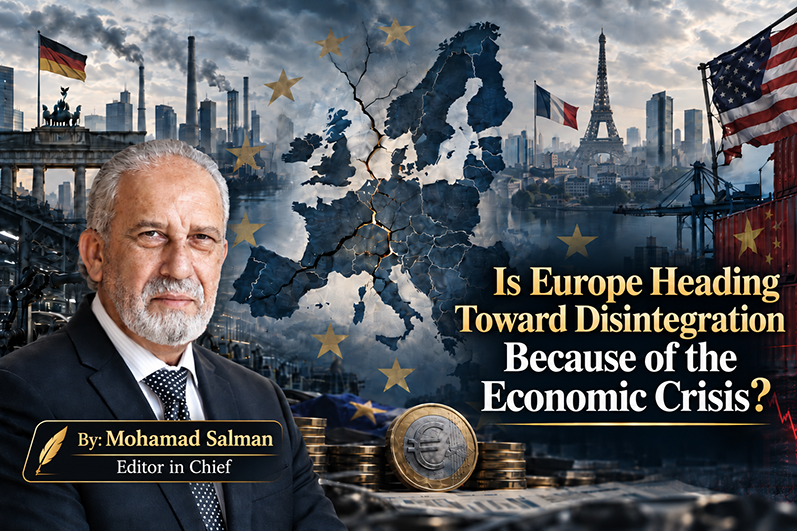

As factories lose momentum, debt rises, and global competition intensifies, can the European Union remain as cohesive as it is today?
By Mohamad Salman – Editor in Chief
When I look at Europe’s economic landscape today, I do not see a temporary slowdown that can simply be solved by lower interest rates or another round of government spending. What I see is a deeper challenge to the economic model that supported much of Europe’s prosperity for decades.
The question is no longer: Is Europe facing an economic crisis?
The real question is: What happens if these pressures continue for years, and could an economic crisis eventually become a political crisis that tests the cohesion of the European Union itself?
I am not saying Europe is inevitably heading toward disintegration. The available data does not support such a conclusion. But when weak growth, rising debt, industrial pressure, a widening trade imbalance with China, and tougher US trade policies all arrive at the same time, it is reasonable to ask: Where is Europe heading?
Germany: What Happened to Europe’s Economic Engine?
To understand the wider European problem, we have to start with Germany, the largest economy in the European Union.
According to the Deutsche Bundesbank, Germany’s public debt reached about €2.84 trillion at the end of 2025, equivalent to 63.5% of GDP.
But I do not believe debt is Germany’s biggest problem.
The more important question is this:
Can Germany’s industrial model continue to work in the same way it did for decades?
Germany built much of its economic strength on cars, machinery, engineering, chemicals, and exports. For years, this model benefited from a large European market, strong Chinese demand, broad access to the US market, and relatively competitive energy costs.
Today, that equation has changed.
China, once one of Germany’s most important growth markets, has also become a direct competitor. The United States has become more protectionist in its trade policy, while energy and investment costs remain a challenge inside Europe.
According to Germany’s Federal Statistical Office, Destatis, the German economy grew by only 0.2% in real terms in 2025, after contracting by 0.5% in 2024 and 0.9% in 2023.
That does not mean the German economy is collapsing. But it does mean that Europe’s largest economy has gone through several years of very weak performance.
That deserves attention.
China: From Major Opportunity to Major Competitor
This may be the most important change in Europe’s economic story.
For many years, European companies saw China as a huge market for their products.
But China developed rapidly, invested heavily in technology, manufacturing, and supply chains, and then started competing with Europe in electric vehicles, batteries, electronics, machinery, and renewable energy.
According to Eurostat, the European Union exported goods worth about €199.6 billion to China in 2025, while importing about €559.4 billion.
That left the EU with a trade deficit of around €359.8 billion with China.
Eurostat also reported that EU exports to China fell by 6.5%, while imports from China rose by 6.4%.
And here is the question I believe Europe must confront:
How long can a major industrial power continue importing at this scale from a competitor while its ability to sell into that competitor’s market is weakening?
Germany and China: A Number That Is Hard to Ignore
The German case makes the problem even clearer.
Data from Destatis shows that Germany imported goods worth €170.6 billion from China in 2025, an increase of 8.8%.
At the same time, German exports to China fell to €81.3 billion, down 9.7%.
As a result, Germany’s trade deficit with China widened to €89.3 billion, from €66.9 billion a year earlier.
In other words, Germany imported more than twice as much from China as it exported there.
That does not mean Germany’s export model has collapsed. Germany still runs a large overall trade surplus.
But it does mean that one of the strongest pillars of its economic model is under increasing pressure.
France: A Different and More Sensitive Problem
If Germany’s main challenge is industrial competitiveness and growth, France faces a more difficult fiscal problem.
According to France’s National Institute of Statistics and Economic Studies, INSEE, French public debt reached about €3.46 trillion at the end of 2025, or 115.6% of GDP.
The government deficit stood at €152.5 billion, equivalent to 5.1% of GDP.
This raises a difficult question.
How does a country with debt at this level continue to finance healthcare, education, defence, infrastructure, energy transition, industrial support, and technology investment at the same time?
Every country can borrow.
But no country can borrow without limit.
As debt-servicing costs rise, the competition inside the national budget becomes more difficult.
Should the money go to investment?
Public services?
Defence?
Or interest payments?
Citizens Do Not Live Inside Economic Tables
This is where I think we sometimes make a mistake when discussing economic crises.
European citizens do not wake up in the morning thinking about debt-to-GDP ratios.
They ask simpler questions.
Is my job secure?
Will the factory in my city still be operating in five years?
Does my salary still cover my living costs?
Will taxes rise?
Will my children have better opportunities than I had?
And when people begin to feel that their standard of living is not improving, they start looking for someone to blame.
The government?
Brussels?
China?
The United States?
Globalisation?
That is the point at which an economic crisis can gradually become a crisis of political trust.
Europe Between China and the United States
The pressure is not coming from the East alone.
Europe also faces a US market that is increasingly willing to use tariffs and industrial policy to protect domestic production.
The result is a difficult position for European manufacturers.
They face stronger Chinese competition in Europe and global markets.
They face stronger local competitors inside China.
And they face tougher trade conditions in the United States.
So where does growth come from?
That may be one of the most important questions for European industry over the next decade.
Could Europe Become a Market for Others?
This is the risk I consider more serious than debt itself.
Europe will remain a large and wealthy consumer market.
But a large market alone does not create economic power.
Economic power comes from producing what others want to buy.
From owning factories.
Technology.
Intellectual property.
Global companies.
And high-value jobs.
If Europe increasingly imports electric vehicles, batteries, electronics, advanced technology, and industrial equipment while losing production capacity in those same sectors, then the problem becomes bigger than the trade deficit.
The real question becomes:
How will Europe finance the high standard of living its citizens expect if its industrial base becomes weaker?
Is China Alone Responsible?
No.
It would be easy to blame China for Europe’s problems, but that would be too simple.
China invested heavily in manufacturing, infrastructure, technology, and supply chains.
Europe also has its own internal problems: high costs, slow procedures in some areas, insufficient investment in certain sectors, and a technology gap with the United States and China in parts of the advanced economy.
That is why Europe cannot simply wait for China to change.
Europe has to change as well.
What If These Conditions Continue for Ten Years?
This is the question that concerns me most.
Europe can absorb one weak year.
Or two.
Perhaps even several.
But what happens if low growth lasts for a decade?
What if debt keeps rising?
What if manufacturing continues to lose market share?
And what if governments also need to spend much more on defence, energy, artificial intelligence, and industrial transformation?
Who pays?
Taxpayers?
Companies?
Future generations through more debt?
Or the wealthier members of the European Union?
That is where economic disagreements can begin to turn into political disagreements between countries.
Does That Mean the European Union Will Break Apart?
Not necessarily.
The economic, legal, and institutional links between EU members are extremely deep, and leaving the Union carries major economic and political costs.
But political cohesion is easier when economies are growing and people feel their lives are improving.
It becomes harder when growth is weak, debt is rising, and industrial jobs are under pressure.
That is the heart of the issue.
Europe is not facing only a debt problem. It is facing a challenge to its economic model.
The world that supported Europe’s prosperity has changed.
China is stronger.
The United States is more protectionist.
Energy has become strategic.
Artificial intelligence, semiconductors, batteries, and advanced manufacturing have become part of economic security.
At the same time, European citizens do not want to give up the public services and living standards they have come to expect.
So, Is Europe Heading Toward Disintegration?
There is no evidence today that allows me to say that Europe is inevitably heading in that direction.
But there is enough evidence to say that the continent is facing one of the most serious tests of its economic and political model in decades.
The real question is not:
Will Europe collapse?
The real question is:
Can Europe change its economic model quickly enough before weak growth, industrial decline, and rising debt become a deeper crisis of political confidence?
If it succeeds, today’s crisis may become the beginning of a new European economic model.
If the same pressures continue for another decade, however, European citizens may begin asking a more dangerous question:
What am I really getting from this system?
And when that question becomes widespread, the debate will no longer be only about economics.
It will become a debate about the future of the European Union itself.