


By Business News I
September 15, 2026
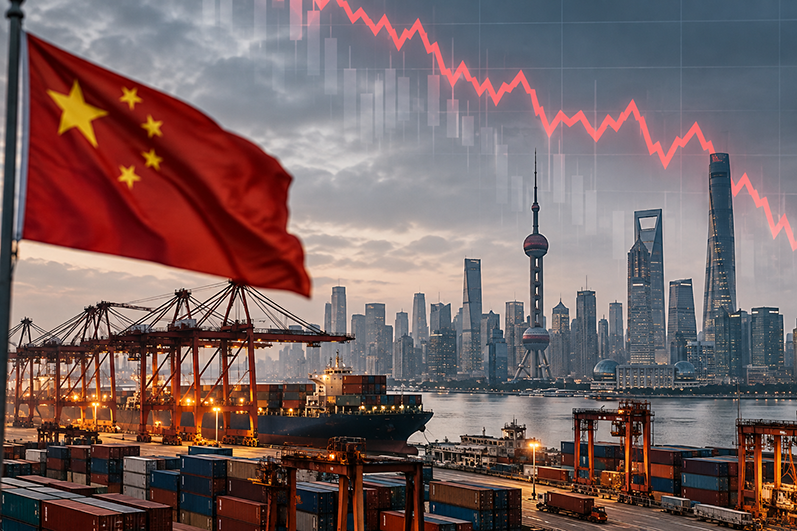
China’s economy showed only a partial improvement in August 2026, with stronger industrial output and exports offset by weak domestic demand, falling investment and continued pressure in the property sector.
According to the National Bureau of Statistics of China, industrial production improved in August, with value-added industrial output rising 5.2% year-on-year, compared with 4.5% in July. Manufacturing grew by 6.1%, while high-tech manufacturing expanded by 16.7%, supported by strong production of lithium-ion batteries, industrial robots and 3D-printing equipment.
However, the broader picture remains uneven. China’s official manufacturing Purchasing Managers’ Index stood at 49.8 in August, below the 50-point level that separates expansion from contraction. The non-manufacturing business activity index was also below that threshold at 49.0, while the services index stood at 49.3. These figures suggest that business activity remains soft despite some improvement in industrial production.
Consumer spending continues to be one of the weakest parts of the economy. Retail sales of consumer goods increased just 0.4% year-on-year in August, while they fell 0.13% month-on-month. During the first eight months of 2026, retail sales were up only 1.1%, indicating that household demand remains subdued. Services consumption performed better, with service retail sales rising 4.9% over the January–August period.
Investment data point to deeper weakness. Fixed-asset investment declined 7.2% year-on-year in the first eight months, compared with a 6.7% decline in January–July. Private-sector investment fell 10.1%, while manufacturing investment dropped 2.3% and infrastructure investment declined 4.0%. The National Bureau of Statistics also reported that fixed-asset investment fell another 0.5% month-on-month in August.
The property sector remains one of the main drags on growth. Real-estate development investment fell 19.9% in the first eight months, while new commercial property sales by floor area declined 12.1% and sales value dropped 13.0%. Funds available to property developers were down 21.0%, highlighting the continuing financing pressure across the sector.
External trade, by contrast, provided significant support. China’s total goods trade increased 19.8% year-on-year in August, with exports up 18.6% and imports rising 21.7%. Over the first eight months, exports increased 14.6%, while imports rose 22.0%.
Inflation also remains relatively modest. Consumer prices rose 0.8% year-on-year in August, while core inflation excluding food and energy increased 1.0%. Producer prices, however, rose more strongly, with the PPI up 3.8% year-on-year, reflecting higher input and commodity costs.
Chinese economists have also pointed to the uneven nature of the recovery. Yicai, one of China’s leading financial media outlets, reported that while August indicators showed some stabilisation, manufacturing remained below the expansion threshold and domestic demand and private investment still required stronger policy support. Its survey of economists suggested that the economy was likely to maintain only a moderate recovery unless household consumption and business confidence improved more decisively.
Overall, the latest Chinese data show an economy that is still expanding in selected areas—particularly advanced manufacturing, technology and exports—but remains constrained by weak consumption, declining investment and a prolonged real-estate downturn.
The National Bureau of Statistics itself acknowledged that the domestic economy continues to face a “strong supply, weak demand” imbalance, alongside pressure on some companies and a still-fragile foundation for recovery.