


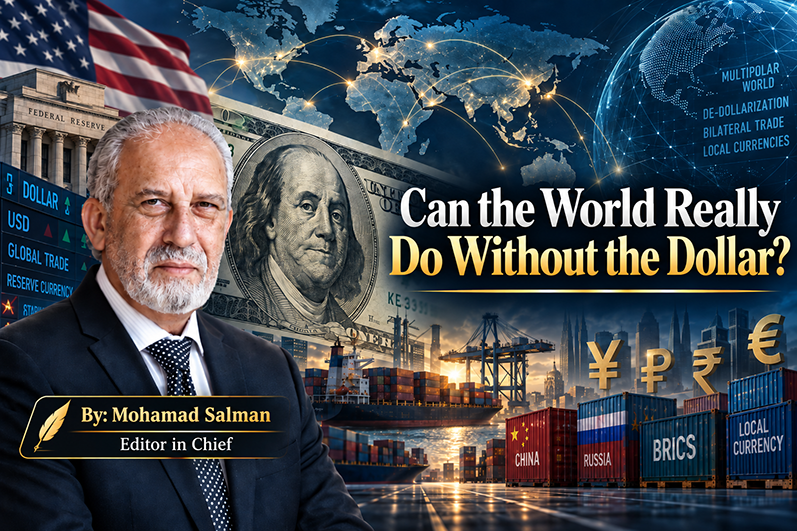

Countries are expanding trade in local currencies, but replacing the dollar is far more complicated than simply deciding not to use it.
By Mohamad Salman – Editor in Chief
For decades, the US dollar has played a role in the global economy that goes far beyond being the currency of the United States.
It has become the common language of international finance: a currency used to price commodities, settle international trade, issue debt, hold reserves, transfer money across borders, and connect currencies that might otherwise have little direct liquidity between them.
Not every international transaction passes through the dollar, of course. The euro, Chinese renminbi, pound sterling, yen, and other currencies are also widely used. But the dollar remains the dominant intermediary currency in global finance.
According to the Bank for International Settlements, the dollar is involved in nearly 90% of global foreign-exchange transactions.
That dominance did not emerge simply because Washington ordered the world to use its currency. It developed over decades because the dollar became deeply embedded in banking, trade, capital markets, reserves, and international contracts.
So the real question is not whether countries can conduct individual transactions without the dollar. Clearly they can.
The more important question is:
Can the world build an international financial system that functions as efficiently without it?
Why Did the Dollar Become So Important?
After the Second World War, the Bretton Woods system placed the dollar at the centre of the international monetary system.
Even after the United States ended the dollar’s formal convertibility into gold in 1971, the currency retained its central position.
Why?
Because the US economy remained large, American financial markets became extraordinarily deep and liquid, and US Treasury securities provided central banks and investors with a huge pool of assets that could be bought and sold easily.
The dollar therefore became much more than a means of payment.
It became a unit of account, store of value, financing currency, reserve asset, and global settlement currency at the same time.
According to the US Federal Reserve, the dollar accounted for about half of international payments recorded through SWIFT in 2024. Around 55% of international and foreign-currency banking claims and roughly 60% of liabilities were also denominated in dollars.
This network effect is extremely difficult to replace.
But Countries Are Trying to Reduce Their Dependence on It
In recent years, a growing number of countries have sought to conduct more trade directly in their own currencies.
Some do so for economic reasons.
Others want to reduce exposure to US monetary policy.
And some want greater protection from financial sanctions and restrictions connected to the dollar-based financial system.
This has encouraged bilateral arrangements involving currencies such as the Chinese renminbi, Indian rupee, Russian ruble, UAE dirham and others.
The idea appears straightforward.
If two countries trade heavily with each other, why should every transaction first be converted into dollars?
Why not settle directly in local currencies?
For certain bilateral trades, this can make perfect sense.
But the difficulties become obvious when the relationship is unbalanced.
What Happens When One Country Sells Much More Than It Buys?
Imagine Country A buys $10 billion worth of goods from Country B, while Country B buys only $2 billion from Country A.
If the two countries settle entirely in their local currencies, Country B may eventually accumulate a large amount of Country A’s currency.
What does it do with it?
If that currency cannot easily be exchanged internationally, invested in deep financial markets, or used to purchase products elsewhere, its usefulness becomes limited.
This is one of the great advantages of the dollar.
A company or government receiving dollars can use them almost anywhere.
They can buy commodities, purchase financial assets, repay debt, hold reserves, or convert them into other major currencies in highly liquid markets.
Most national currencies cannot yet offer the same flexibility.
Could Barter Replace the Dollar?
Some countries can also use forms of barter.
Oil for machinery.
Food for fertiliser.
Raw materials for technology.
Such arrangements may work for particular transactions, especially where financial restrictions make conventional settlement difficult.
But barter does not solve the fundamental problem of valuation.
How many tonnes of wheat equal one piece of industrial equipment?
How many barrels of oil equal a fleet of vehicles?
To answer that question, both sides still need a common reference price.
Very often, even when the physical exchange does not involve dollars, the value of both sides of the transaction may still be calculated using dollar prices.
So the dollar can remain relevant even when it is not physically used for settlement.
The Dollar Has Become a Measuring Stick
One way to understand the dollar’s importance is to think of it as a measuring system for the global economy.
The metre allows two countries to agree on length.
The kilogram provides a common standard for weight.
In a similar way, a widely accepted currency allows businesses in different countries to compare prices quickly.
Oil, metals, agricultural commodities, shipping costs, international loans and many financial contracts have traditionally been priced or benchmarked in dollars.
Replacing that system is possible.
But replacing it with dozens of bilateral arrangements could also create additional exchange-rate risk, hedging costs and complexity.
The Dollar’s Reserve Share Has Declined
None of this means the dollar’s position is untouchable.
Its share of global foreign-exchange reserves has declined considerably over the long term.
According to the International Monetary Fund, the dollar represented 57.13% of allocated global foreign-exchange reserves in the first quarter of 2026, up from 56.42% in the previous quarter but well below the levels seen decades ago.
That decline matters.
But it is equally important to understand what it does not mean.
The world has not simply replaced dollars with one competing currency.
Instead, central banks have gradually diversified into several currencies and other reserve assets.
This is diversification away from complete reliance on the dollar, rather than the emergence of a single new global monetary leader.
Why Has the Chinese Renminbi Not Replaced the Dollar?
China is one of the world’s largest economies and the largest merchandise-trading nation, so the renminbi is often presented as the most obvious potential challenger.
But becoming a global reserve currency requires more than international trade.
Investors and central banks also need deep financial markets, easy convertibility, large supplies of trusted financial assets, and confidence that capital can move freely.
The Chinese financial system still operates with significant capital controls, which limits the international role of the renminbi.
The gap remains substantial.
According to the Federal Reserve’s international-currency-use index for 2024, the dollar scored 64.9, compared with 23.9 for the euro and only 3.1 for the Chinese renminbi.
China can expand the international use of its currency, especially in trade involving Chinese companies.
But replacing the dollar across the entire international financial system is a much larger challenge.
Does This Mean De-Dollarisation Will Fail?
Not necessarily.
I believe one mistake is to imagine only two possible outcomes:
Either the dollar controls everything, or the dollar disappears.
The future is likely to be far more complicated.
More bilateral trade may be settled in local currencies.
The renminbi could become increasingly important in Asian trade.
The euro will remain important across Europe and neighbouring markets.
Digital currencies may also change the technology through which international payments are made.
The world could therefore move gradually from an overwhelmingly dollar-centred system toward a more multipolar currency system.
But that is very different from saying the dollar is about to disappear.
The Digital-Currency Paradox
There is also an interesting contradiction in the argument that digital finance will weaken the dollar.
It may actually strengthen it.
Many of the world’s largest stablecoins are themselves linked to the US dollar.
The Federal Reserve estimated that about 99% of stablecoin market capitalisation was dollar-linked in the data reviewed for its 2025 analysis.
In other words, new technology may change how dollars move around the world without necessarily changing the currency in which value is measured.
The payment rail changes.
The underlying monetary standard may not.
What Would Happen If the Dollar Really Lost Its Dominant Position?
Some countries would gain greater independence from the American financial system.
They could potentially reduce their exposure to US sanctions and to movements in US monetary policy.
But the international economy could also become more fragmented.
One group of countries could settle primarily in dollars.
Another could use the renminbi.
Europe could rely more heavily on the euro.
Others might use multiple regional or bilateral systems.
Politically, that might offer countries greater autonomy.
Economically, however, it could also mean more complexity and higher transaction costs.
One global financial language might gradually be replaced by several regional ones.
The Dollar Was Not Made Global by a Single Decision
This, in my view, is the most important point.
The dollar did not become the world’s leading currency simply because the United States declared that it should.
Millions of companies, banks, investors and governments chose to use it over decades because the financial infrastructure around it was convenient, liquid and widely trusted.
For the same reason, the dollar cannot be removed from the global economy simply through political declarations.
It is easy for two countries to announce that they will trade without dollars.
It is much harder to create a replacement that works everywhere.
A true alternative would need to function simultaneously as:
a trade currency,
a reserve asset,
a financing currency,
an investment instrument,
a global payment mechanism,
and a safe haven during financial crises.
So far, no single alternative provides all of these functions on the same scale.
Will the Dollar Dominate Forever?
No currency remains dominant forever.
The British pound once occupied the position that the dollar holds today.
Economic power changes.
Technology changes.
Trade patterns change.
And eventually the international monetary system may change as well.
But the evidence today points to a more gradual transformation.
The dollar is facing greater competition.
Countries are experimenting with local-currency settlement.
Central banks are diversifying their reserves.
China is promoting broader international use of the renminbi.
Digital payments are changing global finance.
Yet the dollar remains deeply embedded in foreign exchange, banking, debt markets, international payments and reserves.
Perhaps, then, we are asking the wrong question.
Instead of asking:
Can the world do without the dollar?
We should ask:
What currency—or what financial system—can provide the world with the same liquidity, convertibility, trust, scale and flexibility that the dollar provides today?
Until there is a convincing answer to that question, the world may gradually reduce its dependence on the dollar.
But replacing it entirely is another matter altogether.