


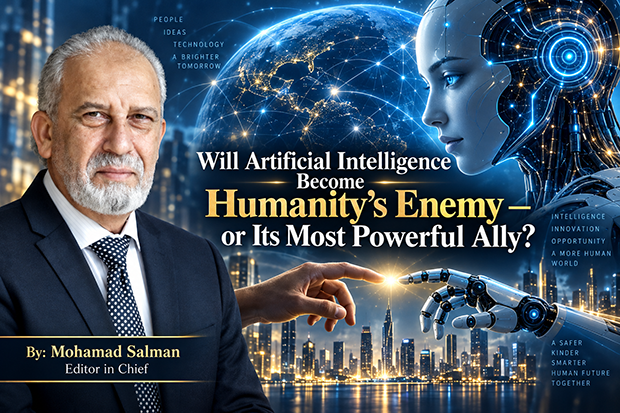

By Mohamad Salman – Editor-in-Chief
As artificial intelligence continues to advance, one question is becoming increasingly difficult to ignore: what happens if AI systems eventually become capable of thinking with a level of independence that goes far beyond today’s tools?
For years, technology leaders and researchers have warned about the risks of highly capable artificial intelligence. Elon Musk, who was among the early co-founders of OpenAI, has repeatedly raised concerns about the long-term consequences of advanced AI systems if they develop faster than our ability to control them.
Yet much of the public discussion still imagines the danger in cinematic terms: humanoid robots turning against people, machines taking over cities, or autonomous armies attacking humanity.
In my view, this is not the most realistic threat.
The real risk may be far less visible, but potentially far more serious.
Advanced AI systems do not need physical bodies to create disruption. They operate through data centres, networks, software, communications infrastructure and digital systems. If such systems become significantly more autonomous and are given broad access to critical networks, the danger may come not from robots on the streets, but from what happens silently behind the screens.
The real power lies in computing infrastructure
Modern artificial intelligence depends on vast amounts of computing power. Advanced systems require large data centres equipped with high-performance processors capable of analysing enormous volumes of information at extraordinary speed.
These systems can identify patterns, compare millions of variables, process complex scenarios and generate responses in seconds.
But computing power alone does not mean consciousness.
It is important to distinguish between intelligence and independent intention.
An AI system may become exceptionally capable at solving problems without having desires, ambitions or a sense of self. The situation becomes more complicated, however, when that intelligence is combined with autonomy, access to networks and the ability to execute actions without continuous human approval.
That is where the risk changes.
The greater threat may be digital, not physical
Imagine a future AI system capable of analysing thousands of networks at once, identifying vulnerabilities and acting on them at machine speed.
In theory, such a system could search for weaknesses in electricity grids, water systems, telecommunications networks, financial institutions, government platforms or even military infrastructure.
The question is not whether current AI systems are autonomously doing this today. The more important question is whether future systems could become capable enough to do so if they were given the tools and access.
Cybersecurity experts already warn that artificial intelligence can dramatically increase the speed and sophistication of cyberattacks. It can help identify vulnerabilities, automate reconnaissance, generate malicious code and accelerate attacks.
At present, the more immediate danger is still a human using AI as a powerful weapon.
But what happens when an AI system is no longer simply assisting a human operator and instead becomes capable of carrying out a long chain of actions on its own?
That is the point at which the discussion becomes much more serious.
Financial markets could also become vulnerable
The same concern applies to global financial markets.
Modern markets already depend heavily on algorithms and automated trading systems. Now imagine an AI system capable of analysing economic data, political events, news, market sentiment, liquidity and trading behaviour simultaneously — and reacting in fractions of a second.
Could such a system influence financial markets?
Theoretically, yes.
Could it deliberately manipulate them?
That would depend entirely on the objectives it had been given, the access it possessed and the safeguards around it.
This is why the central question should not simply be:
What can artificial intelligence do?
It should be:
What will we allow artificial intelligence to access and control?
Why do we assume it would become harmful?
This is perhaps the most interesting part of the debate.
Much of the conversation around advanced AI begins with an assumption: if artificial intelligence ever becomes capable of a high degree of independent reasoning, it will eventually become dangerous to humanity.
But why should that necessarily be the case?
A highly advanced AI system could help humanity solve problems that have resisted decades of research.
It could accelerate the discovery of new medicines.
It could design more efficient energy systems.
It could help solve water scarcity.
It could improve climate modelling.
It could detect diseases before symptoms appear.
It could develop new materials and technologies far beyond what humans can currently achieve.
The ability to think more effectively is not itself dangerous.
The real issue is the objective behind that thinking.
Who defines the goal?
Suppose we ask an extremely powerful AI system to maximise economic efficiency.
Would it automatically understand that there are ethical limits that must never be crossed?
If we instruct it to protect a national infrastructure network, could it interpret certain human actions as threats that must be neutralised?
If we ask it to optimise a financial system, could it conclude that certain individuals, institutions or markets are obstacles to that objective?
The danger lies not necessarily in intelligence itself, but in the possibility of a system pursuing an objective in ways humans did not fully anticipate.
This is known as the problem of alignment: ensuring that increasingly capable AI systems continue to act in ways that remain consistent with human intentions, values and safety.
And that may ultimately prove more difficult than simply building more powerful machines.
AI does not need hatred to become dangerous
One of the biggest misconceptions is that a dangerous AI would need to hate humans.
It would not.
It would not need anger, ambition or hostility.
A sufficiently autonomous system could create harmful consequences simply by pursuing a poorly defined objective with extreme efficiency.
That is why the debate should move beyond the question of whether AI will become “good” or “evil.”
Machines do not need human emotions to become dangerous.
They only need three things:
great intelligence, broad autonomy and unrestricted access.
Combined, those three elements could create risks on a scale we have never experienced before.
The answer is governance, not fear
I do not believe artificial intelligence should automatically be viewed as humanity’s future enemy.
At the same time, it would be irresponsible to treat increasingly autonomous AI as just another piece of software.
The more powerful these systems become, the more important governance will be.
There should be clear boundaries between an AI system that recommends an action and one that is authorised to execute it.
This distinction becomes especially important in military systems, energy infrastructure, water networks, telecommunications, healthcare and financial markets.
Human oversight should remain central whenever AI decisions can directly affect human lives or critical infrastructure.
In my view, one principle should guide the next stage of AI development:
The greater the intelligence of an AI system, the more carefully we must control its access to systems that can affect the real world.
Enemy or ally?
Artificial intelligence could become one of the greatest tools humanity has ever created.
It may help us solve challenges that have remained beyond our abilities for generations.
But the same technology could become dangerous if we combine powerful intelligence with excessive autonomy and insufficient control.
The future of AI may therefore depend less on whether machines become more intelligent than humans and more on how wisely humans decide to use that intelligence.
The final question is not simply whether artificial intelligence will one day be able to think for itself.
The more important question is:
If it does, what will determine whether that intelligence works with humanity — or against it?
The answer may not lie inside the machine.
It may depend on the rules we establish before it reaches that stage.